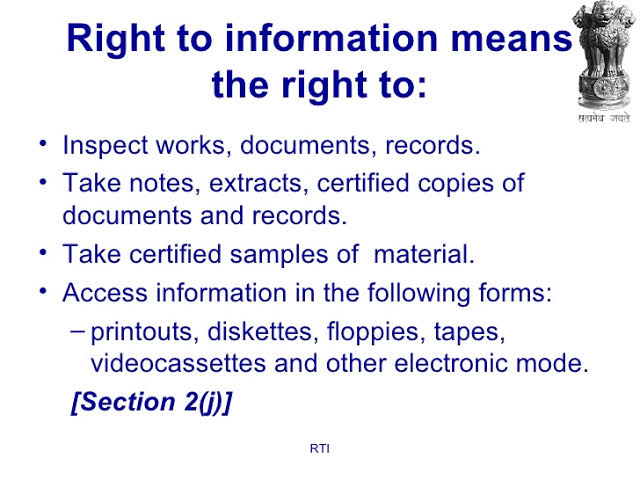
Right to Information (RTI) is act of the Parliament of India to provide for setting out the practical regime of the right to information for citizens and replaces the erstwhile freedom of information act 2002.Under the provisions of the Act, any citizen of India may request information from a “public authority” (a body of Government or “instrumentality of State”) which is required to reply expeditiously or within thirty days. The Act also requires every public authority to computerise their records for wide dissemination and to proactively certain categories of information so that the citizens need minimum recourse to request for information formally. It was introduced
Recently the government passed an amendment Bill in 2019.
The Right to Information (Amendment) Bill, 2019 was introduced in Lok Sabha by the Minister of State for Personnel, Public Grievances and Pensions, Mr. Jitendra Singh, on July 19, 2019. It seeks to amend the Right to Information Act, 2005. Key features of the Bill include:
Term of Information Commissioners: Under the Act, Chief Information Commissioner (CIC) and Information Commissioners (ICs) are appointed at the national and state level to implement the provisions of the Act. The Act states that the CIC and other ICs (appointed at the central and state level) will hold office for a term of five years. The Bill removes this provision and states that the central government will notify the term of office for the CIC and the ICs.
Determination of salary: The Act states that the salary of the CIC and ICs (at the central level) will be equivalent to the salary paid to the Chief Election Commissioner and Election Commissioners, respectively. Similarly, the salary of the CIC and ICs (at the state level) will be equivalent to the salary paid to the Election Commissioners and the Chief Secretary to the state government, respectively.
The Bill seeks to amend these provisions to state that the salaries, allowances, and other terms and conditions of service of the central and state CIC and ICs will be determined by the central government.
Deductions in salary: The Act states that at the time of the appointment of the CIC and ICs (at the central and state level), if they are receiving pension or any other retirement benefits for previous government service, their salaries will be reduced by an amount equal to the pension.
Previous government service includes service under: (i) the central government, (ii) state government, (iii) corporation established under a central or state law, and (iv) government company owned or controlled by the central or state government.
The Bill removes these provisions
Uncomfortable RTI pleas in background
This comes in the backdrop of a few orders of the information commission that were considered uncomfortable for the Modi government in recent times. Two examples can be gauged from PM Modi’s degree row and the status of non-performing assets in public sector banks.
In January 2017, acting on an RTI activist’s application, information commissioner Sridhar Acharyulu ordered the Delhi University to allow inspection of records of students who had passed BA course in 1978, the year in which Prime Minister Narendra Modi passed the examination.
Within the next couple of days, Sridhar Acharyulu was stripped of human resource development portfolio. Then Chief Information Commissioner RK Mathur took away HRD ministry from him. Interestingly, in a reshuffle within the central information commission on December 29, 2016, Acharyulu had retained HRD ministry in his portfolio.
In another incident from the previous Modi government’s tenure, the Reserve Bank of India had been directed on an RTI application, to provide details of the NPA in public sector banks and the details of big loan defaulters. The RBI had denied revealing information sought citing confidential nature of the same.
The matter reached the Supreme Court, which first in 2015, directed the RBI to make the information available and reiterated the order in April this year after the central bank failed to comply with the order.
What’s government’s defence?
The government has maintained that it has not tinkered with autonomy or independence of the central information commission. Minister of State in the Prime Minister’s Office Jitendra Singh while introducing the RTI Amendment Bill 2019 in the Lok Sabha on Monday said the Modi government is correcting the anomaly in the RTI law passed by the UPA government.
He said, “Probably, the then government of the day, in a hurry to pass the RTI Act, 2005, overlooked a lot of things. The Central Information Commissioner has been given the status of a Supreme Court judge but his judgments can be challenged in the high courts. How can that exist?”
“The RTI Act did not give the government rule-making powers. We are merely correcting these through the amendment,” Singh said.
Post-script
Interestingly, the central information commission has six information commissioners. Four posts of information commissioners are lying vacant with the Opposition citing the vacancies to accuse the Modi government of attempting to weaken the institution and check flow of information.
One curious connection before we conclude. The original RTI Act was passed after it was discussed and cleared by the Parliamentary Committee on Personnel, Public Grievances, Law and Justice. In the original bill, the salaries of the CIC and ICs were equivalent to secretaries and additional secretaries respectively.
But the parliamentary committee recommended increasing the same to the level of the chief election commissioner and other election commissioners for the CIC and the ICs respectively. The parliamentary committee that recommended the change included then BJP MPs Ram Nath Kovind (now the President), Ram Jethmalani (no longer with the BJP) and Balavant Apte.

 Rocket